 blog
blog
Hydro Jetting Cost for Restaurants: What to Expect
Table of Contents
- What Drives Hydro Jetting Cost for Restaurants
- Signs Your Restaurant Needs Hydro Jetting
- Commercial Hydro Jetting vs Snaking: Which Costs Less Long-Term
- How Often Should Restaurants Hydro Jet Drains
- Emergency Service vs Scheduled Maintenance Pricing
- The ROI of Preventative Hydro Jetting and Health Code Compliance
- Conclusion
- Frequently Asked Questions
Last Updated: September 13, 2026
What Drives Hydro Jetting Cost for Restaurants
Hydro jetting cost for restaurants depends on four variables: pipe diameter, line length, accessibility, and how much grease has hardened inside the line. No two quotes land in the same place because no two drainage systems fail the same way.
This guide from Jersey Shore Sewer & Drain Cleaning breaks down what moves the number up or down, when snaking is the smarter spend, and how to time service around your health inspections instead of your emergencies.
The single biggest driver is not the equipment. It is access.
Pipe Diameter, Length, and Accessibility
Wider pipes hold more water, so they take longer to jet and need larger nozzles and higher flow rates. A 2-inch branch line under a prep sink clears quickly; a 6-inch main sewer line running the length of a building does not.
Length compounds the problem. A long horizontal run needs more passes, more hose, and more time on site. Accessibility decides how much of that time is spent working versus opening the way in.
- Floor drains under fixed equipment require pulling the fixture or cutting an access point
- Lines behind finished walls or under slab concrete add labor before jetting even starts
- Roof vents and cleanouts in tight mechanical rooms slow the setup
- Grease trap integration points often need to be opened and pumped before jetting begins
A common mistake is assuming the quote reflects the clog. It usually reflects the access.
Blockage Severity and Grease Buildup
Soft, recent grease clears fast. Grease that has cooled, hardened, and bonded to the pipe wall does not. Add food solids, paper, and mineral scale, and the crew is essentially chiseling the line back to bare pipe.
Severity also changes the equipment. Light buildup may need only a standard nozzle; heavier blockages often call for a penetrating nozzle or chain cutter attachment, which takes longer and costs more in labor.
Signs Your Restaurant Needs Hydro Jetting
Watch for five signals: multiple slow drains, recurring clogs in the same line, gurgling floor drains, standing water near the grease trap, and sewage odor in the kitchen. Two or more together usually mean the main line is partially blocked, not just one fixture.
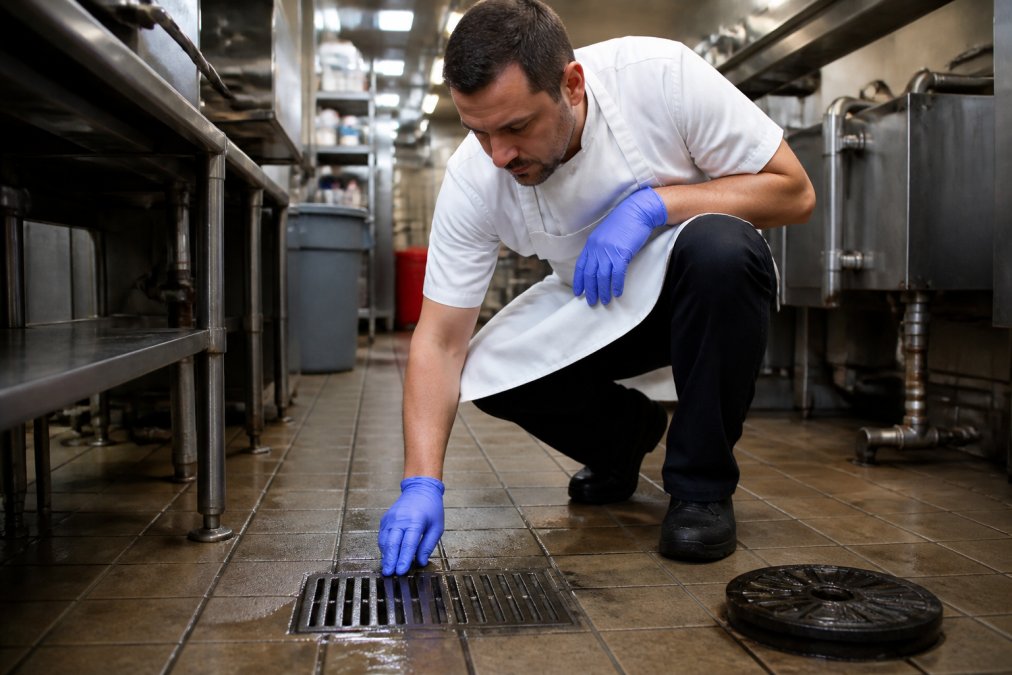
One slow drain is a fixture problem. Three slow drains on the same line is a system problem, and snaking will not solve it.
Other signs worth acting on:
- Drain flies appearing around floor drains or the grease trap
- Water backing up into a second sink when you run the first
- Repeated clogs within 30 to 60 days of the last clearing
- Foul odors that persist after routine cleaning
Many restaurant owners describe the same pattern: a plumber comes out three times in a year for the same clog, clears it, and leaves. That cycle is the clearest sign that the line needs jetting, not another snake.
Commercial Hydro Jetting vs Snaking: Which Costs Less Long-Term
Hydro jetting costs more per visit than snaking, but snaking often costs more over a year because it treats symptoms, not the cause. Snaking punches a hole through a blockage; jetting scours the full interior of the pipe.
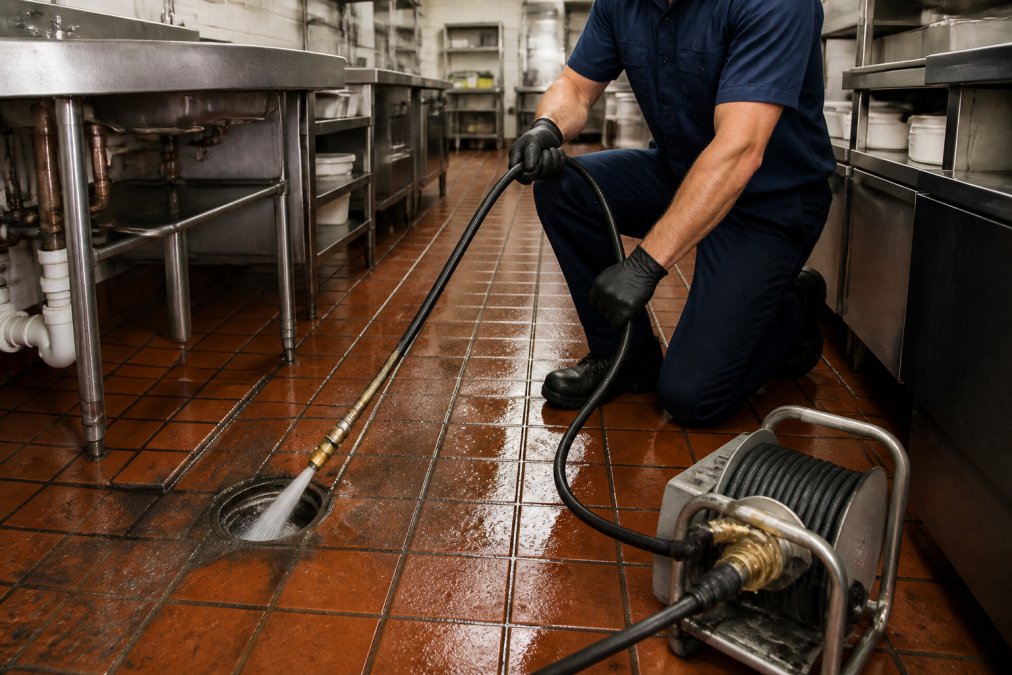
That distinction decides everything downstream. A snake leaves grease on the pipe wall, so the line re-clogs faster. A hydro-jetting machine strips the buildup back to the pipe surface with high-pressure water, resetting the clock on the next clog.
| Factor | Snaking | Hydro Jetting |
|---|---|---|
| Upfront cost | Lower | Higher |
| Removes grease from pipe walls | No | Yes |
| Clears roots and scale | Limited | Yes |
| Typical re-clog window | Weeks to months | Months to years |
| Best for | Small branch lines | Main sewer lines |
When Snaking Is Enough
Snaking works for a single fixture with a simple, soft blockage: a sink drain, a short branch line, a wad of food debris. It is fast, inexpensive, and appropriate when the problem is genuinely local.
If the clog is in one drain and the rest of the system flows normally, snaking is a reasonable first move. Just do not expect it to hold if grease is the underlying cause.
When Only Hydro Jetting Works
Hydro jetting is the only real option when the blockage sits in the main sewer line, grease has hardened onto pipe walls, tree roots have entered the line, or the same drain keeps clogging. A snake cannot remove what it cannot reach.
For commercial kitchens, the main line is where the money lives. If that line is compromised, no amount of snaking will keep the kitchen compliant.
How Often Should Restaurants Hydro Jet Drains
Most commercial kitchens need hydro jetting every 6 to 12 months, with high-volume fryer and grill operations on the shorter end. The right interval depends on your grease output, grease trap size, and how well staff manages FOG (fats, oils, and grease) at the source.
Restaurants that fry heavily, render a lot of fat, or run long service hours tend to need quarterly service. Cafes and lighter kitchens can often stretch to annual.
Grease Trap Integration and Service Timing
Your grease trap and drain lines are one system, not two. If the trap is undersized or pumped infrequently, grease escapes into the main line and accelerates buildup downstream. That is why the best time to hydro jet is right after a grease trap pump-out.
Sequence the work correctly and you get more value from both services:
- Pump and clean the grease trap
- Hydro jet the lines downstream of the trap
- Run a video inspection to confirm the line is clear
- Log the date so you can schedule the next service before the line slows again
Emergency Service vs Scheduled Maintenance Pricing
Emergency service always costs more than scheduled service. The gap comes from a predictable set of pricing mechanics every commercial plumbing company builds into its rate card.
What Actually Makes Emergency Work Cost More
- After-hours multipliers. Most companies charge premium rates for nights, weekends, and holidays, often time-and-a-half or double-time on top of the standard hourly rate (Overtime Pay).
- Dispatch and trip charges. Emergency calls carry a higher trip fee because the crew is pulled off planned work or called in from standby.
- Minimum service charges. Many companies set a higher minimum, so even a short job bills at a floor price.
- Overtime labor hours. A two-person crew working a holiday backup bills two overtime rates, not one.
- Equipment mobilization. Pulling a hydro-jetting truck and hose reel out of schedule adds billed setup time.
Scheduled maintenance flips every one of those line items. You book during business hours, the crew arrives on a planned route, and the quote is locked before anyone touches a drain.
The Real Cost Is the Closed Kitchen
The invoice is the small number. The big number is what a backup costs you in lost operating hours.
Walk through a Friday-night backup:
- Lost covers. A dining room that seats 80 and turns twice on a Friday is 160 covers. At an average check of $30, that is roughly $4,800 in food and beverage revenue gone in one service (Press Releases).
- Staff wages. Servers, cooks, and dishwashers are already clocked in, and you pay them whether the kitchen runs or not.
- Spoiled product. Idle refrigeration and prep lines can force you to discard mid-service product.
- Emergency premium. The after-hours invoice itself.
- Reputation damage. A customer who finds a closed dining room on a Friday does not always come back.
Stack those together and a single emergency backup can easily run into five figures in total impact, far more than a year of scheduled jetting.
Why Scheduled Service Is Cheaper on Every Axis
Scheduled hydro jetting is priced predictably, can be bundled with grease trap pumping and video inspection, and lets you choose the crew you trust instead of whoever answers the phone at 11 p.m.
Jersey Shore Sewer & Drain Cleaning offers free quotes on scheduled commercial work, which is a big part of why property managers keep us on a maintenance calendar instead of a speed dial.
The ROI of Preventative Hydro Jetting and Health Code Compliance
Most articles on hydro jetting cost stop at the invoice. What matters to a restaurant owner is the cost of the backup you did not have, and the inspection you did not fail.
Running the Preventative Maintenance Math
Preventative hydro jetting pays for itself against the true cost of one emergency. Here is the framework most operators use:
- Scheduled jetting: predictable, quoted in advance, often bundled with grease trap pumping and video inspection at a package rate.
- Emergency jetting: after-hours premium, higher trip charge, higher minimum, overtime labor, plus the operational losses below.
- Operational loss per backup: lost covers for one service, wages for staff already on the clock, spoiled product, and the emergency invoice itself.
- Inspection risk: a documented drainage violation can trigger a re-inspection fee, a mandated correction window, and in serious cases a temporary closure.
A common pattern among commercial kitchen operators is that one avoided emergency backup covers the cost of a full year of scheduled jetting. That is the ROI case in a single sentence.
What Health Inspectors Actually Look At
Health department walkthroughs treat wastewater and drainage as a core category, not an afterthought (the FDA). Inspectors commonly check:
- Floor drains, clear, flowing, and free of standing water
- Grease traps and interceptors, properly sized, serviced on a documented schedule, and not overflowing
- Wastewater backup, any evidence of sewage backup or standing wastewater in a food prep or storage area
- Indirect waste connections, proper air gaps and drainage from prep sinks and dish machines
- Plumbing maintenance records, service logs that show the system is being maintained, not just repaired
A slow drain you knew about and did not fix becomes a documented violation the moment an inspector sees standing water near a prep station. That is the difference between a maintenance line item and a compliance problem.
Why This Is the Angle Most Guides Miss
Most hydro jetting cost articles treat the service as a standalone plumbing expense. For a restaurant, it is a compliance and continuity expense: the line between your grease trap, drain lines, and inspection record is the same line, and keeping it clean is cheaper than explaining why it was not.
For restaurants, the ROI math is simple: one avoided emergency pays for a year of scheduled jetting.
Conclusion
Every restaurant owner faces the same choice: react to a backup at the worst possible moment, or schedule the work on your terms. Hydro jetting cost for restaurants is not a fixed number, but the decision behind it is straightforward. Preventative service is cheaper than emergency service and protects your kitchen, staff, and inspection record.
Jersey Shore Sewer & Drain Cleaning has served commercial kitchens since 1990 as a licensed, bonded, and insured team offering 24/7 emergency service, same-day appointments, and free quotes. Our crews use high-pressure hydro jetting and video inspections to clear the line and prove it is clear.
Call the plumber now and get your kitchen back on a maintenance schedule before the next backup chooses the timing for you.
Frequently Asked Questions
How much does hydro jetting cost for a commercial kitchen?
Hydro jetting cost for a commercial kitchen depends on pipe diameter, length, blockage severity, and accessibility. Restaurants typically pay more than residential jobs because commercial sewer lines are larger, grease buildup is heavier, and work often happens outside business hours. Request a service quote from a licensed provider who will inspect the line first, since pricing varies widely based on your drainage situation and plumbing infrastructure.
Why is hydro jetting more expensive for restaurants than residential properties?
Commercial kitchens produce far more grease buildup than a home kitchen, and their main sewer lines are wider and longer. Hydro jetting a restaurant often requires larger equipment, longer hose runs, and grease trap integration work. Emergency service calls during service hours also raise the price. A residential drain might clear in under an hour, while a restaurant line can take several hours with a hydro-jetting machine and camera inspection.
How often should restaurants hydro jet drains?
Most full-service restaurants need hydro jetting every 6 to 12 months, but high-volume kitchens with heavy fryer use may need it quarterly. If your grease trap is undersized or pump-outs are infrequent, grease travels further into the sewer line and clogs return faster. Pairing scheduled service with regular grease trap maintenance keeps drainage efficiency high and reduces the chance of a sewer backup during peak hours.
Is hydro jetting safe for older restaurant pipes?
Licensed technicians run a video pipe inspection before hydro jetting to check pipe integrity and material. High-pressure water can damage severely corroded or cracked lines, so the pressure and nozzle type must match the pipe condition. If the inspection shows failing pipes, the technician should recommend repair or replacement instead. On sound cast iron or PVC lines, hydro jetting removes grease and clog removal debris without harming the pipe.